

When sourcing custom metal components, choosing between die casting and investment casting directly impacts your unit cost, dimensional accuracy, lead time, and overall product performance.
While both processes produce high-precision metal parts, they serve fundamentally different manufacturing volume requirements, material constraints, and geometric complexities.

| Feature / Metric | Die Casting | Investment Casting (Lost Wax) |
| Tooling & Setup Cost | High ($10,000 – $100,000+) | Low to Moderate |
| Economic Production Volume | High volume (>10,000 pcs/yr) | Low to Medium (<5,000 pcs/yr) & Prototyping |
| Dimensional Tolerance | ±0.1 – 0.2 mm (ISO CT6–CT8) | ±0.05 – 0.1 mm (ISO CT4–CT6) |
| As-Cast Surface Roughness | Ra 1.6 – 3.2 µm (Smooth finish) | Ra 3.2 – 6.3 µm |
| Applicable Alloys | Non-ferrous only (Aluminum, Zinc, Mag) | Universal (Stainless steel, Superalloys, Titanium) |
| Wall Thickness Minimum | 0.8 – 4.0 mm (Thin-walled preferred) | Flexible (Grams to 100+ kg) |
| Internal Complexity | Simple/Moderate (Requires sliding cores for undercuts) | High (Complex internal cores/passages) |
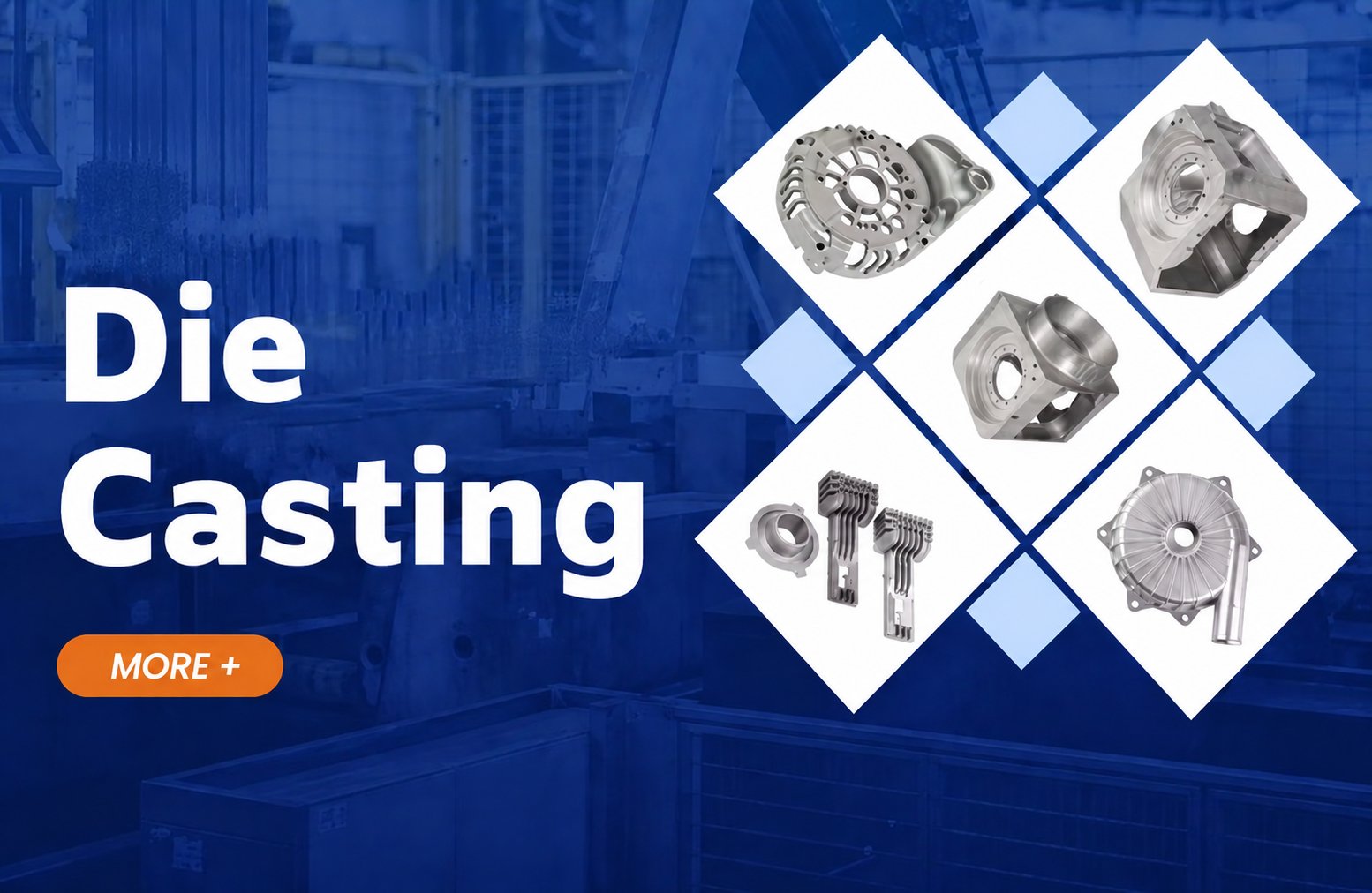
Die Casting: Requires hardened steel dies. High initial tooling expenditure is offset by extremely fast cycle times, making the cost per part drastically low at scale (>10k pcs/year).
Investment Casting: Utilizes wax patterns and ceramic shells with lower upfront tooling costs, but higher labor per part. It remains the most economical choice for lower annual volumes (<5k pcs/year) or rapid iterations.
Die Casting: Offers excellent repeatability with standard tolerances around ±0.1–0.2 mm. However, long thin walls or large flat surfaces are susceptible to thermal warping during cooling.
Investment Casting: Delivers industry-leading precision at ±0.05–0.1 mm. Zero draft angles are often achievable, reducing or eliminating secondary machining for tight-tolerance features.
Die Casting: Produces a dense, smooth surface finish (Ra 1.6–3.2 µm), frequently ready for anodizing, powder coating, or immediate assembly without further surface prep.
Investment Casting: Yields a slightly textured surface (Ra 3.2–6.3 µm) due to the ceramic shell mold. Achieving die-cast smoothness requires secondary bead blasting or electropolishing.
Die Casting: Limited strictly to non-ferrous alloys with high melt fluidity—primarily Aluminum (A380, ADC12), Zinc (ZAMAK), and Magnesium. Cannot cast iron, steel, or high-temperature alloys.
Investment Casting: Compatible with virtually any castable metal, including 304/316 Stainless Steel, Carbon Steel, Tool Steel, Cobalt-Chrome, Inconel, and Titanium—making it essential for aerospace, medical, and high-wear industrial applications.
Choose Die Casting if:
Your annual production volume exceeds 10,000 units.
Your part material is Aluminum, Zinc, or Magnesium.
Your component requires thin walls, fast production cycles, and minimal finishing.
Choose Investment Casting if:
Your design specifies Stainless Steel, Carbon Steel, or Nickel-based Superalloys.
The part features complex internal channels, deep cavities, or zero draft angle requirements.
Your volume is below 5,000 pieces/year or currently in the prototyping phase.
Unsure which process offers the lowest Total Cost of Ownership (TCO) for your project?
Our engineering team provides Dual-Process Design for Manufacturing (DFM) Reviews alongside firm commercial quotes.
Send us your 3D CAD models (STEP/IGES)
Specify your target annual volume & material spec
Receive a tailored ROI comparison & DFM feedback within 48 hours

Add: Room 2-2703, Building 2, NO.11 Zaoyuan Road, Licang District, Qingdao, China.
Email: sales@compass-casting.com
Tel: +86 0532-80913852
Inquiry email: cora@compass-casting.com
Copyright © 2016-2020 Qingdao Compass Hardware Co., Ltd., All Rights Reserved. Powered by HiCheng.
